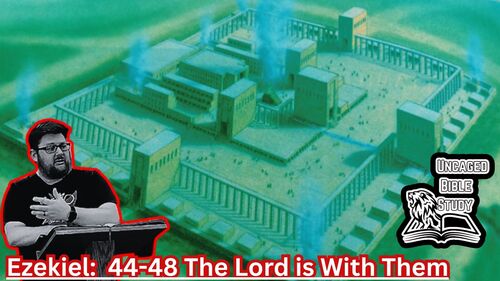
The Lord is With Them: Ezekiel 44-48
The Lord is There: Understanding Ezekiel's Final Vision
The closing chapters of Ezekiel paint one of Scripture's most intricate and fascinating prophetic pictures—a detailed vision of a future temple, a restored land, and God dwelling permanently with His people. While the architectural specifications and tribal allotments might seem overwhelming at first glance, they all point toward one breathtaking truth: "The Lord is there."
A Temple Like No Other
Ezekiel's vision describes a temple structure that has never existed in human history. Though it shares similarities with Solomon's temple and the second temple, the measurements and arrangements are unique. This isn't a reconstruction of something past—it's a revelation of something future.
What makes this temple extraordinary isn't merely its architecture. It's the eastern gate, permanently shut after the Lord enters, signifying He will never leave. No more temporary dwelling. No more departing glory. God will be present with His people forever.
This detail alone should make us pause. Throughout Israel's history, God's presence came and went. The glory departed from Solomon's temple. The second temple never experienced the same manifestation of God's presence. But in Ezekiel's vision, the gate closes behind the Lord—He's staying.
A Priesthood Restored and Refined
The vision includes a functioning Levitical priesthood, complete with sacrifices, offerings, and ceremonial practices. For many readers, this raises an immediate question: Why would there be sacrifices after Christ's perfect, once-for-all sacrifice on the cross?
The answer may lie in understanding these practices not as atonement for sin—Christ accomplished that—but as a profound teaching moment. Consider Israel's long history: 3,500 years of either no priesthood, corrupted priesthood, or misunderstood priesthood. They went through the motions of sacrifices without grasping what those sacrifices pointed toward. When their Messiah came, religious tradition had so clouded their understanding that they missed Him entirely.
Now imagine this: Christ returns, sits enthroned in their midst, and the faithful finally get to practice those ancient rituals while looking directly at the One they always pointed toward. It's not about earning salvation—it's about finally understanding what was always meant to be understood. Every lamb, every offering, every ceremony suddenly makes perfect sense because the Lamb of God is right there.
The sons of Zadok, priests who remained faithful, receive the highest honor—direct ministry in Christ's presence. The rest of the priesthood serves, but with a new comprehension of what their service means. This isn't punishment; it's sanctification. It's the lesson they'll never forget.
Living Water Flows
One of the most beautiful elements of Ezekiel's vision is the river flowing from the temple. Starting as a trickle at the threshold, it becomes ankle-deep, then knee-deep, then waist-deep, until finally it's a river too deep to cross—one that must be swum.
This living water flows eastward, ultimately reaching the sea and healing its waters. Where this river goes, life flourishes. Fish multiply. Trees bearing fruit every month line its banks, their leaves providing medicine.
This imagery connects with other prophetic scriptures. Zechariah predicted that when the Messiah's feet touch the Mount of Olives, it will split from north to south, and living water will flow from Jerusalem toward both the eastern and western seas. Remarkably, geological surveys in the 1960s discovered exactly what Scripture describes: a fault line running through the Mount of Olives with an underground water source beneath it.
Jesus called Himself the "living water." In Ezekiel's vision, that living water becomes physically manifest, bringing healing and restoration to a world that experienced judgment. The book of Revelation describes waters turning bitter and poisonous during the tribulation. This river reverses that curse, making the waters fresh and teeming with life again.
The Land Restored
The vision meticulously details how the land of Israel will be divided among the twelve tribes. This isn't a return to previous boundaries—this is the fulfillment of the complete promise God made to Abraham. The full extent of the Promised Land, never fully conquered even under Joshua, will finally belong to God's people.
Each tribe receives its allotment. At the center sits the holy district—a perfect square containing the temple, the city, and the dwelling places for the priests. The measurements are precise. The arrangements are specific. This is the fulfillment of ancient promises.
Joseph receives a double portion, just as Jacob blessed his sons Ephraim and Manasseh centuries earlier. The gates of the city bear the names of the twelve tribes. Everything comes full circle.
Why This Matters
Some interpret these chapters as purely metaphorical—perhaps representing the church as God's temple, believers as His royal priesthood. While there's theological truth in understanding the church this way, the specific details in Ezekiel seem to resist purely symbolic interpretation.
The naming of specific tribes, the geographical markers, the precise measurements, the connection to other prophetic scriptures—all of this points toward literal fulfillment. This is a message to Israel about Israel's future, when they will finally understand everything they missed.
But there's application for all believers here too. The ultimate message transcends tribal boundaries: God desires to dwell with His people. The tabernacle in the wilderness, Solomon's temple, the incarnation of Christ, the indwelling Holy Spirit, and this future temple all express the same divine longing—God wants to be with us.
The Name That Says Everything
After nine chapters of intricate detail—measurements, allotments, regulations, and descriptions—the vision concludes with a single, powerful declaration: the name of this city shall be "The Lord is There."
All the architectural specifics, all the ceremonial instructions, all the tribal arrangements—they all exist to make one point. God will dwell with His people. Not temporarily. Not conditionally. But permanently and completely.
This is what the tabernacle always meant to be. This is what every sacrifice pointed toward. This is the fulfillment of every promise, the answer to every longing, the completion of every prophecy.
The Lord is there.
And one day, in ways we can barely imagine, He will be here—dwelling with His people in perfect, unbroken fellowship forever. That's not just Israel's hope. It's the hope of everyone who belongs to Him.
The closing chapters of Ezekiel paint one of Scripture's most intricate and fascinating prophetic pictures—a detailed vision of a future temple, a restored land, and God dwelling permanently with His people. While the architectural specifications and tribal allotments might seem overwhelming at first glance, they all point toward one breathtaking truth: "The Lord is there."
A Temple Like No Other
Ezekiel's vision describes a temple structure that has never existed in human history. Though it shares similarities with Solomon's temple and the second temple, the measurements and arrangements are unique. This isn't a reconstruction of something past—it's a revelation of something future.
What makes this temple extraordinary isn't merely its architecture. It's the eastern gate, permanently shut after the Lord enters, signifying He will never leave. No more temporary dwelling. No more departing glory. God will be present with His people forever.
This detail alone should make us pause. Throughout Israel's history, God's presence came and went. The glory departed from Solomon's temple. The second temple never experienced the same manifestation of God's presence. But in Ezekiel's vision, the gate closes behind the Lord—He's staying.
A Priesthood Restored and Refined
The vision includes a functioning Levitical priesthood, complete with sacrifices, offerings, and ceremonial practices. For many readers, this raises an immediate question: Why would there be sacrifices after Christ's perfect, once-for-all sacrifice on the cross?
The answer may lie in understanding these practices not as atonement for sin—Christ accomplished that—but as a profound teaching moment. Consider Israel's long history: 3,500 years of either no priesthood, corrupted priesthood, or misunderstood priesthood. They went through the motions of sacrifices without grasping what those sacrifices pointed toward. When their Messiah came, religious tradition had so clouded their understanding that they missed Him entirely.
Now imagine this: Christ returns, sits enthroned in their midst, and the faithful finally get to practice those ancient rituals while looking directly at the One they always pointed toward. It's not about earning salvation—it's about finally understanding what was always meant to be understood. Every lamb, every offering, every ceremony suddenly makes perfect sense because the Lamb of God is right there.
The sons of Zadok, priests who remained faithful, receive the highest honor—direct ministry in Christ's presence. The rest of the priesthood serves, but with a new comprehension of what their service means. This isn't punishment; it's sanctification. It's the lesson they'll never forget.
Living Water Flows
One of the most beautiful elements of Ezekiel's vision is the river flowing from the temple. Starting as a trickle at the threshold, it becomes ankle-deep, then knee-deep, then waist-deep, until finally it's a river too deep to cross—one that must be swum.
This living water flows eastward, ultimately reaching the sea and healing its waters. Where this river goes, life flourishes. Fish multiply. Trees bearing fruit every month line its banks, their leaves providing medicine.
This imagery connects with other prophetic scriptures. Zechariah predicted that when the Messiah's feet touch the Mount of Olives, it will split from north to south, and living water will flow from Jerusalem toward both the eastern and western seas. Remarkably, geological surveys in the 1960s discovered exactly what Scripture describes: a fault line running through the Mount of Olives with an underground water source beneath it.
Jesus called Himself the "living water." In Ezekiel's vision, that living water becomes physically manifest, bringing healing and restoration to a world that experienced judgment. The book of Revelation describes waters turning bitter and poisonous during the tribulation. This river reverses that curse, making the waters fresh and teeming with life again.
The Land Restored
The vision meticulously details how the land of Israel will be divided among the twelve tribes. This isn't a return to previous boundaries—this is the fulfillment of the complete promise God made to Abraham. The full extent of the Promised Land, never fully conquered even under Joshua, will finally belong to God's people.
Each tribe receives its allotment. At the center sits the holy district—a perfect square containing the temple, the city, and the dwelling places for the priests. The measurements are precise. The arrangements are specific. This is the fulfillment of ancient promises.
Joseph receives a double portion, just as Jacob blessed his sons Ephraim and Manasseh centuries earlier. The gates of the city bear the names of the twelve tribes. Everything comes full circle.
Why This Matters
Some interpret these chapters as purely metaphorical—perhaps representing the church as God's temple, believers as His royal priesthood. While there's theological truth in understanding the church this way, the specific details in Ezekiel seem to resist purely symbolic interpretation.
The naming of specific tribes, the geographical markers, the precise measurements, the connection to other prophetic scriptures—all of this points toward literal fulfillment. This is a message to Israel about Israel's future, when they will finally understand everything they missed.
But there's application for all believers here too. The ultimate message transcends tribal boundaries: God desires to dwell with His people. The tabernacle in the wilderness, Solomon's temple, the incarnation of Christ, the indwelling Holy Spirit, and this future temple all express the same divine longing—God wants to be with us.
The Name That Says Everything
After nine chapters of intricate detail—measurements, allotments, regulations, and descriptions—the vision concludes with a single, powerful declaration: the name of this city shall be "The Lord is There."
All the architectural specifics, all the ceremonial instructions, all the tribal arrangements—they all exist to make one point. God will dwell with His people. Not temporarily. Not conditionally. But permanently and completely.
This is what the tabernacle always meant to be. This is what every sacrifice pointed toward. This is the fulfillment of every promise, the answer to every longing, the completion of every prophecy.
The Lord is there.
And one day, in ways we can barely imagine, He will be here—dwelling with His people in perfect, unbroken fellowship forever. That's not just Israel's hope. It's the hope of everyone who belongs to Him.
Recent
Archive
2026
January
February
March
June
2025
November
1 Kings 18: Showdown on Mt. CarmelOccupy Till He Comes, Daniel 12The Book of Ezra; And Billy GrahamGog and Magog invasion: Ezekiel 38 & 39October 31stFinding the Mission through Despair: 1 Kings 19The Trinity and VictoryNehemiah: Building for God and the Arrival of MessiahThe Eternal Mystery: Understanding the Nature of GodWicked Royalty, Faithful Citizen, a Vineyard, and a ProphetFor Such a Time as ThisThe Millennial TempleRepentance is Necessary: 2 Kings 1
Categories
no categories
No Comments