Sola Scriptura: Scriptura alone
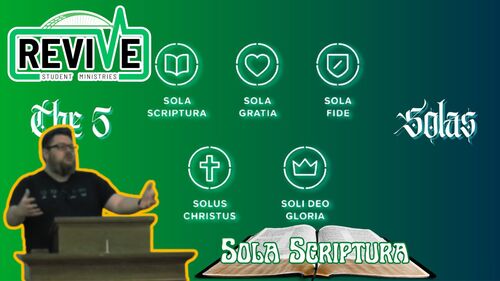
The Authority of Scripture: Understanding Sola Scriptura
The tension is palpable. For centuries, a fundamental question has divided Christian traditions: What is the ultimate authority for faith and practice? This question strikes at the heart of how we understand truth, interpret divine revelation, and organize church life.
At the center of this discussion stands the doctrine of sola scriptura—Scripture alone as the only infallible rule of faith for the church. This isn't a claim that church authority or historical councils have no value. Rather, it positions all human authorities under Scripture, ensuring that church decisions and traditions cannot contradict what God has revealed in His Word.
The Paradox Jesus Presented
Consider this compelling paradox: Jesus consistently held people accountable to Scripture. He would say, "You have heard it said," or "have you not read?" He challenged the Pharisees and Sadducees by appealing to what was written in the Old Testament.
But here's the question that demands an answer: How could Jesus hold Jewish religious leaders accountable to Scripture if they supposedly needed a church magisterium to tell them what belonged in Scripture? How could they know what was authoritative if the canon wasn't officially "decided" for another 1,500 years?
This paradox reveals the truth. There was a standard for Old Testament Scripture in the 1st century; and it was the scrolls that were laid up in the Temple: the 39books of the Old Testament Canon.
The Unity Question
Critics often point to Protestant denominational diversity as evidence against sola scriptura. The claim of "45,000 Protestant denominations" gets thrown around as proof of chaos and division. But this argument misses something fundamental about how Protestants understand unity.
Protestant unity isn't based on institutional uniformity. It's based on the gospel of Jesus Christ. Lutherans, Methodists, Baptists, Presbyterians, and non-denominational believers can worship together, take communion together, and recognize each other as brothers and sisters in Christ—not because they agree on every doctrinal detail, but because they're united in the essentials of the faith.
Meanwhile, traditions that claim institutional unity have experienced significant schisms. The Assyrian Church of the East split in 431 AD. The Oriental Orthodox Church separated in 451 AD. The Eastern Orthodox and Roman Catholic churches excommunicated each other for centuries. Within Eastern Orthodoxy, you find the Greek Orthodox, Russian Orthodox, True Orthodox, and Old Believers—groups that often don't recognize each other's validity. Roman Catholicism has its own schismatic groups like the Old Catholics and Sedevacantists.
The point isn't to disparage these traditions, but to recognize that institutional claims to unity often mask deeper divisions, while gospel-centered unity transcends denominational boundaries.
The Canon Question
Did Protestants remove books from the Bible? This accusation suggests that Martin Luther and other reformers arbitrarily deleted seven books from Scripture. But history tells a different story.
The Protestant Old Testament contains 39 books—the exact books that Jewish authorities recognized as Scripture and stored in the temple during Jesus' earthly ministry. These were the scrolls the Pharisees, whom Jesus acknowledged as sitting in Moses' seat, considered authoritative.
Jesus Himself defined the Old Testament canon when He spoke of "the Law of Moses, the Prophets, and the Psalms" (Luke 24:44). This threefold division corresponds precisely to the 39-book Hebrew canon. None of the disputed apocryphal books fall into these categories.
Interestingly, many early church fathers—including Jerome, who translated the Latin Vulgate—agreed with this shorter canon. Even Cardinal Cajetan, who interviewed Martin Luther during the Reformation, agreed with Luther on the 66-book canon.
The expanded canon wasn't universally affirmed until the Council of Trent (1545-1563), which met specifically in response to the Reformation. Protestants didn't remove books; they maintained the canon that Jesus and the apostles affirmed.
The tension is palpable. For centuries, a fundamental question has divided Christian traditions: What is the ultimate authority for faith and practice? This question strikes at the heart of how we understand truth, interpret divine revelation, and organize church life.
At the center of this discussion stands the doctrine of sola scriptura—Scripture alone as the only infallible rule of faith for the church. This isn't a claim that church authority or historical councils have no value. Rather, it positions all human authorities under Scripture, ensuring that church decisions and traditions cannot contradict what God has revealed in His Word.
The Paradox Jesus Presented
Consider this compelling paradox: Jesus consistently held people accountable to Scripture. He would say, "You have heard it said," or "have you not read?" He challenged the Pharisees and Sadducees by appealing to what was written in the Old Testament.
But here's the question that demands an answer: How could Jesus hold Jewish religious leaders accountable to Scripture if they supposedly needed a church magisterium to tell them what belonged in Scripture? How could they know what was authoritative if the canon wasn't officially "decided" for another 1,500 years?
This paradox reveals the truth. There was a standard for Old Testament Scripture in the 1st century; and it was the scrolls that were laid up in the Temple: the 39books of the Old Testament Canon.
The Unity Question
Critics often point to Protestant denominational diversity as evidence against sola scriptura. The claim of "45,000 Protestant denominations" gets thrown around as proof of chaos and division. But this argument misses something fundamental about how Protestants understand unity.
Protestant unity isn't based on institutional uniformity. It's based on the gospel of Jesus Christ. Lutherans, Methodists, Baptists, Presbyterians, and non-denominational believers can worship together, take communion together, and recognize each other as brothers and sisters in Christ—not because they agree on every doctrinal detail, but because they're united in the essentials of the faith.
Meanwhile, traditions that claim institutional unity have experienced significant schisms. The Assyrian Church of the East split in 431 AD. The Oriental Orthodox Church separated in 451 AD. The Eastern Orthodox and Roman Catholic churches excommunicated each other for centuries. Within Eastern Orthodoxy, you find the Greek Orthodox, Russian Orthodox, True Orthodox, and Old Believers—groups that often don't recognize each other's validity. Roman Catholicism has its own schismatic groups like the Old Catholics and Sedevacantists.
The point isn't to disparage these traditions, but to recognize that institutional claims to unity often mask deeper divisions, while gospel-centered unity transcends denominational boundaries.
The Canon Question
Did Protestants remove books from the Bible? This accusation suggests that Martin Luther and other reformers arbitrarily deleted seven books from Scripture. But history tells a different story.
The Protestant Old Testament contains 39 books—the exact books that Jewish authorities recognized as Scripture and stored in the temple during Jesus' earthly ministry. These were the scrolls the Pharisees, whom Jesus acknowledged as sitting in Moses' seat, considered authoritative.
Jesus Himself defined the Old Testament canon when He spoke of "the Law of Moses, the Prophets, and the Psalms" (Luke 24:44). This threefold division corresponds precisely to the 39-book Hebrew canon. None of the disputed apocryphal books fall into these categories.
Interestingly, many early church fathers—including Jerome, who translated the Latin Vulgate—agreed with this shorter canon. Even Cardinal Cajetan, who interviewed Martin Luther during the Reformation, agreed with Luther on the 66-book canon.
The expanded canon wasn't universally affirmed until the Council of Trent (1545-1563), which met specifically in response to the Reformation. Protestants didn't remove books; they maintained the canon that Jesus and the apostles affirmed.
What the Church Fathers Said
Did early Christians believe in sola scriptura? Consider these remarkable statements:
Augustine, one of the most influential Western fathers, wrote: "I do not accept their teaching as true on the mere ground of the opinion being held by them, but only because they have succeeded in convincing my judgment of its truth, either by means of these canonical writings themselves or by arguments addressed to my reason."
John Chrysostom, the most influential Eastern father, addressed those confused about which church faction to join: "If we bid you believe the Scriptures, these are simple and true. The decision is easy for you. If any agree with the Scriptures, he is a Christian. If any fight against them, he is far from this rule."
These fathers understood that Scripture, not institutional authority, defines authentic Christianity.
Scripture's Own Testimony
The Bible itself teaches its unique authority. Paul wrote that "all Scripture is given by inspiration of God and is profitable for doctrine, for reproof, for correction, for instruction in righteousness, that the man of God may be complete, thoroughly equipped for every good work" (2 Timothy 3:16-17).
Notice that phrase: "thoroughly equipped for every good work." Scripture provides everything necessary for spiritual maturity and faithful living.
This standard began with Moses, who commanded that Israel's future kings write a copy of the Law and read it daily (Deuteronomy 17:18-19). Joshua continued this practice, writing God's words in the Book of the Law (Joshua 24:26). The prophets received divine commands to write down revelation. John was told to write what he saw in Revelation.
The pattern is clear: God's revelation was meant to be written and preserved as an objective standard.
The Problem with Oral Tradition
If oral tradition were incorruptible, why did Paul need to write so many corrective letters? He established churches through personal teaching, yet repeatedly discovered they had strayed from what he taught them. His written letters became Scripture precisely because oral tradition proved corruptible.
Paul even warned the Galatians: "If anyone preaches any other gospel to you than what you have received, let him be accursed" (Galatians 1:9). Then he clarified the gospel in writing so there would be no confusion.
When Paul visited Berea, he commended the believers there because "they received the word with all readiness, and searched the Scriptures daily to find out whether these things were so" (Acts 17:11). They tested apostolic teaching against Scripture—and Paul praised them for it.
Reason and Revelation
Romans 1:20 declares that through creation itself, people "are without excuse" for rejecting God. Natural revelation provides enough evidence that everyone bears responsibility for responding to God.
If fallen humans can recognize God through nature without institutional guidance, how much more should they be able to understand when God provides specific, written revelation about salvation? The claim that Scripture requires an institutional interpreter contradicts God's own standard for human accountability.
The New Testament Canon
How can we know which books belong in the New Testament without church councils? By examining apostolic authorship and recognition.
Peter acknowledged Paul's writings as Scripture (2 Peter 3:16). Paul quoted Luke's Gospel as Scripture (1 Timothy 5:18). This apostolic recognition establishes a clear chain: Peter affirms Paul, Paul affirms Luke, and these direct disciples of Jesus wrote or endorsed 25 of the 27 New Testament books. The remaining two—James and Jude—were written by Jesus' own brothers after His resurrection.
The New Testament canon is self-authenticating through apostolic authority.
The Heart of the Matter
Sola scriptura isn't about dismissing church history, rejecting theological wisdom, or claiming every doctrine must be explicitly stated in Scripture. It's about recognizing that Scripture alone is the infallible foundation upon which everything else must be built.
Church councils can err. Traditions can become corrupted. Even well-meaning leaders can mislead. But God's written Word stands forever as the unchanging standard of truth.
This doctrine doesn't produce chaos—it produces freedom. Freedom to test all teaching against an objective standard. Freedom to unite around the gospel rather than institutional loyalty. Freedom to trust that God has given us everything we need in His Word.
The question isn't whether we value church tradition or respect spiritual authority. The question is whether anything can stand above Scripture as our rule of faith. History, reason, and Scripture itself all point to the same answer: Nothing can.
Did early Christians believe in sola scriptura? Consider these remarkable statements:
Augustine, one of the most influential Western fathers, wrote: "I do not accept their teaching as true on the mere ground of the opinion being held by them, but only because they have succeeded in convincing my judgment of its truth, either by means of these canonical writings themselves or by arguments addressed to my reason."
John Chrysostom, the most influential Eastern father, addressed those confused about which church faction to join: "If we bid you believe the Scriptures, these are simple and true. The decision is easy for you. If any agree with the Scriptures, he is a Christian. If any fight against them, he is far from this rule."
These fathers understood that Scripture, not institutional authority, defines authentic Christianity.
Scripture's Own Testimony
The Bible itself teaches its unique authority. Paul wrote that "all Scripture is given by inspiration of God and is profitable for doctrine, for reproof, for correction, for instruction in righteousness, that the man of God may be complete, thoroughly equipped for every good work" (2 Timothy 3:16-17).
Notice that phrase: "thoroughly equipped for every good work." Scripture provides everything necessary for spiritual maturity and faithful living.
This standard began with Moses, who commanded that Israel's future kings write a copy of the Law and read it daily (Deuteronomy 17:18-19). Joshua continued this practice, writing God's words in the Book of the Law (Joshua 24:26). The prophets received divine commands to write down revelation. John was told to write what he saw in Revelation.
The pattern is clear: God's revelation was meant to be written and preserved as an objective standard.
The Problem with Oral Tradition
If oral tradition were incorruptible, why did Paul need to write so many corrective letters? He established churches through personal teaching, yet repeatedly discovered they had strayed from what he taught them. His written letters became Scripture precisely because oral tradition proved corruptible.
Paul even warned the Galatians: "If anyone preaches any other gospel to you than what you have received, let him be accursed" (Galatians 1:9). Then he clarified the gospel in writing so there would be no confusion.
When Paul visited Berea, he commended the believers there because "they received the word with all readiness, and searched the Scriptures daily to find out whether these things were so" (Acts 17:11). They tested apostolic teaching against Scripture—and Paul praised them for it.
Reason and Revelation
Romans 1:20 declares that through creation itself, people "are without excuse" for rejecting God. Natural revelation provides enough evidence that everyone bears responsibility for responding to God.
If fallen humans can recognize God through nature without institutional guidance, how much more should they be able to understand when God provides specific, written revelation about salvation? The claim that Scripture requires an institutional interpreter contradicts God's own standard for human accountability.
The New Testament Canon
How can we know which books belong in the New Testament without church councils? By examining apostolic authorship and recognition.
Peter acknowledged Paul's writings as Scripture (2 Peter 3:16). Paul quoted Luke's Gospel as Scripture (1 Timothy 5:18). This apostolic recognition establishes a clear chain: Peter affirms Paul, Paul affirms Luke, and these direct disciples of Jesus wrote or endorsed 25 of the 27 New Testament books. The remaining two—James and Jude—were written by Jesus' own brothers after His resurrection.
The New Testament canon is self-authenticating through apostolic authority.
The Heart of the Matter
Sola scriptura isn't about dismissing church history, rejecting theological wisdom, or claiming every doctrine must be explicitly stated in Scripture. It's about recognizing that Scripture alone is the infallible foundation upon which everything else must be built.
Church councils can err. Traditions can become corrupted. Even well-meaning leaders can mislead. But God's written Word stands forever as the unchanging standard of truth.
This doctrine doesn't produce chaos—it produces freedom. Freedom to test all teaching against an objective standard. Freedom to unite around the gospel rather than institutional loyalty. Freedom to trust that God has given us everything we need in His Word.
The question isn't whether we value church tradition or respect spiritual authority. The question is whether anything can stand above Scripture as our rule of faith. History, reason, and Scripture itself all point to the same answer: Nothing can.
Recent
Archive
2026
January
February
March
June
2025
November
1 Kings 18: Showdown on Mt. CarmelOccupy Till He Comes, Daniel 12The Book of Ezra; And Billy GrahamGog and Magog invasion: Ezekiel 38 & 39October 31stFinding the Mission through Despair: 1 Kings 19The Trinity and VictoryNehemiah: Building for God and the Arrival of MessiahThe Eternal Mystery: Understanding the Nature of GodWicked Royalty, Faithful Citizen, a Vineyard, and a ProphetFor Such a Time as ThisThe Millennial TempleRepentance is Necessary: 2 Kings 1
Categories
no categories
No Comments